


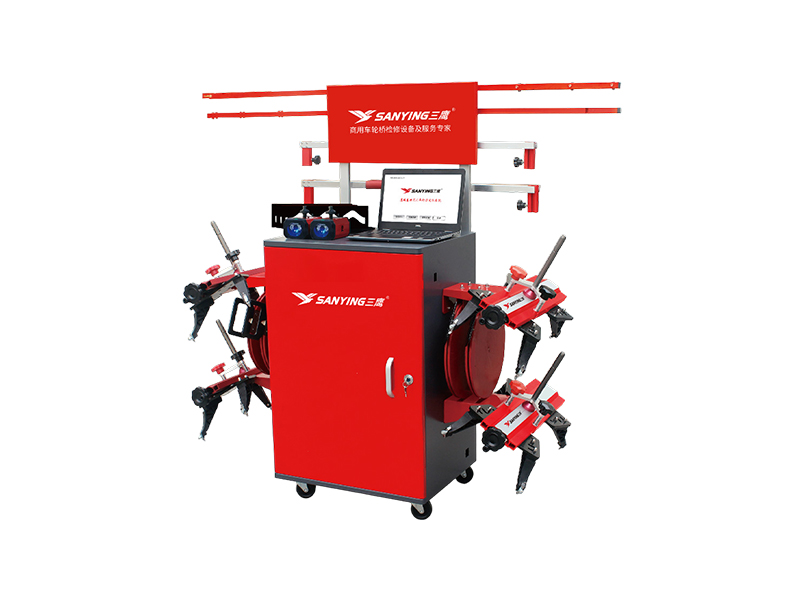
Product Configuration and Characteristics
• Measurement mode: New camera measurement mode with complete functions and simple operation.
• Measurement basis: Scientific 3D modeling based on the frame's geometric centerline ensures accurate, stable and reliable measurement.
• Measurement type: Fully computerized measurement according to process; one machine for unified testing of tractors and trailers, fast, efficient and worry-free.
• Measurement parameters: Toe-in, camber, maximum steering angle, axle deflection, lateral displacement and many other parameters.
• Transmission method: WIFI communication with smooth and stable signals, low power consumption and long-distance transmission.
• Standby time: The camera can work continuously for more than 14 hours.
• Resistant to temperature changes, magnetic field interference, and strong light interference.
• The camera has a self-calibration function and strong adaptability to various working conditions.
• Core components are made of 7-series aluminum alloy.
• One machine for unified testing, no need for conversion, low maintenance cost and high efficiency.
• Simple and fast operation process, increasing efficiency by 2-3 times.
• Miniaturized components, resistant to bumps, and convenient for mobile operations.
| First of its kind in China | Application advantages | Applicable Vehicle Models | ||
| New camera-based wheel axle positioning system | Full computerized measurement | Strong applicability to working conditions | Truck | Light truck |
| Quick and convenient operation | Stable and reliable performance | Mobile operation on any flat site, serving frontline needs | Bus | Articulated trucks |
| Accurate measurement | Effective positioning | 10-year warranty for worry-free use | Half-hung | Special vehicles |
Where is the difference?
| Product Category | Measurement Basis | Measurable Parameters | Measurement Mode | Site adaptability | Transmission method | Accuracy | Environmental resistance | Maintenance | Operation process | Portability | Service life | Standby time | Maintenance costs |
Camera-based wheel axle positioning system vs. photoelectric positioning system | 3D modeling of frame centerline with mutual reference between | Axle deflection, lateral displacement, toe-in, camber, maximum steering angle, etc. (camera-based) vs. basic parameters like toe-in and camber (photoelectric). | Fully computerized unified testing with one machine (camera-based) vs | Self-calibration function has strong applicability to working conditions | WIFI communication with smooth and stable signals, low power consumption and long-distance transmission | High | Stronger adaptability to temperature, magnetic fields and strong light (camera-based) vs. sensitivity to temperature changes, magnetic interference and direct sunlight (photoelectric) | No frequent calibration needed (camera-based) vs | Simple and fast operation process, increasing efficiency by 2-3 times | Miniaturized, bump-resistant components for easy mobile operation (camera-based) vs. large, cumbersome sensors (photoelectric) | More than 10 years | 12 hours | Low |
Photoelectric positioning system | Left and right camera sensors (camera-based) vs. basic benchmarks (photoelectric) | Basic parameters such as toe in and camber | Combined testing with multiple devices requiring model-specific replacement (photoelectric) | No self-calibration function | Bluetooth or Zigbee, high power consumption, poor signal at weak current | Higher | Afraid of temperature changes Afraid of magnetic field interference Afraid of direct sunlight | calibration required every 6 months or after site changes (photoelectric) | Many steps, low efficiency | Sensors and other components are large and inconvenient to carry | 3-8 years | 5-8 hours | High |
 +86-535-6853226 +86-535-6500316
 No. 14, Wuxi Road, Yantai Development Zone, China

 EN
EN
